
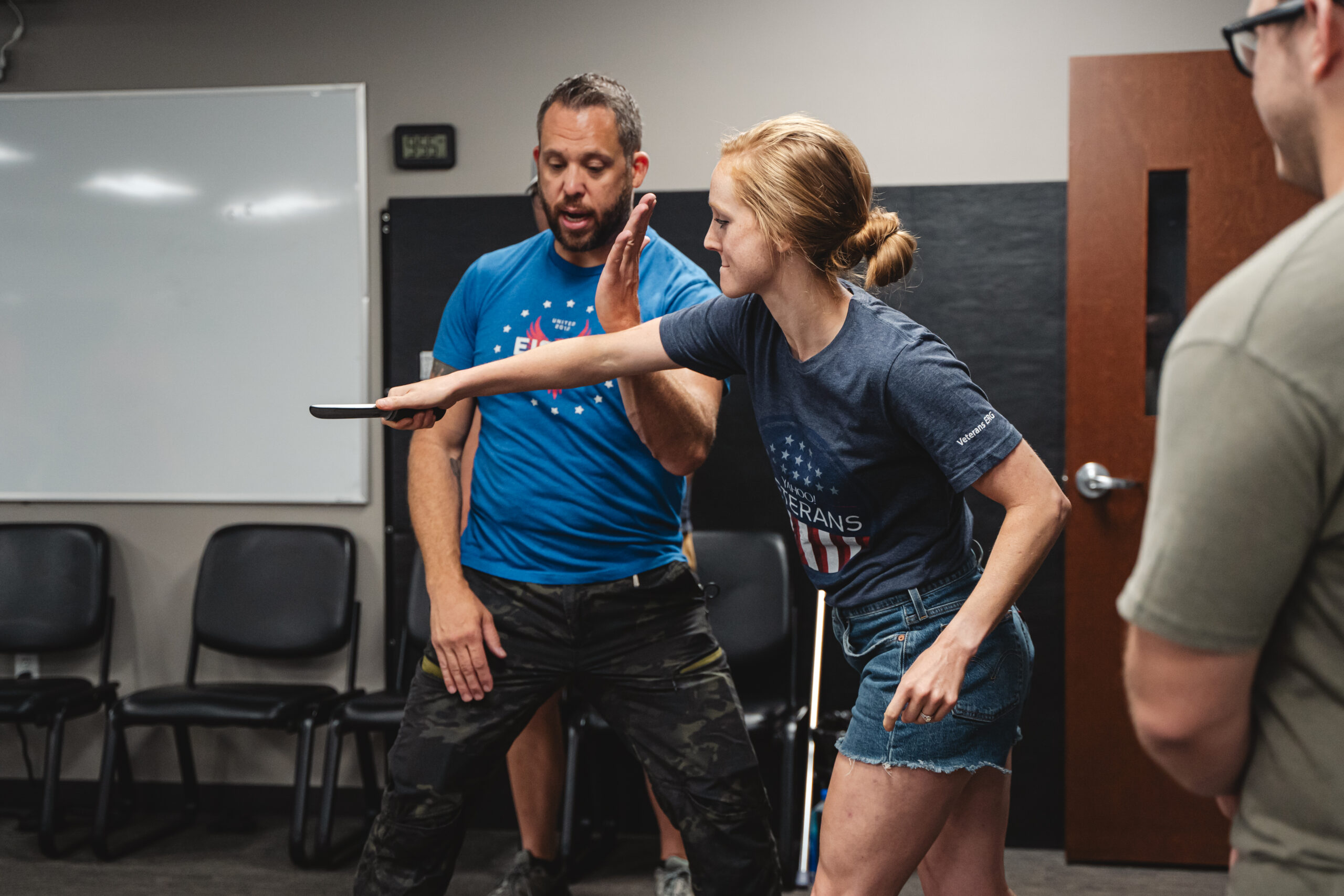
Building Skill, Judgment, and Compliance in Nebraska
In our previous article, Choosing the Right Knife for Everyday Carry: A Practical Guide Rooted in Combative Principles, we focused on selection—choosing a blade that balances utility, concealability, and combative reliability. Once that foundation is laid, the next conversation must be about how that knife fits into personal defense, when it can lawfully be carried, and the responsibility that comes with treating a blade as a deadly weapon.
This article continues that progression:
EDC knives are tools first, weapons only when unavoidable—and they are always legal liabilities if misunderstood.
Knife Defense Is Not Knife Fighting
One of the most common misconceptions around knives is the idea of “knife fighting.” Real-world defensive knife use is not a duel, not sport fencing, and not choreography.
A defensive knife exists to:
- Create space
- Disrupt grips or clinches
- Stop an imminent, unlawful threat when escape is not possible
From a use‑of‑force perspective, a knife is deadly force, regardless of intent. Nebraska law explicitly treats knives as deadly weapons depending on blade length and use, not motive alone. [nebraskale…lature.gov], [nebraskale…lature.gov]
This is why reputable training emphasizes:
- Avoidance and disengagement
- Retention and access under stress
- Rapid decision-making under legal constraints
If you carry a knife for defense, you must understand that every defensive deployment is legally equivalent to using a firearm in terms of scrutiny and consequences.
Defensive Knife Use as a Last Resort
In combative doctrine, knives live in the fail-safe category—tools for when distance has collapsed and higher‑order solutions are unavailable.
Common defensive contexts include:
- Weapon retention failures
- Close‑quarters ambushes
- Grounded or clinched entanglements
- Multiple attackers at contact distance
From a legal standpoint, Nebraska courts evaluate deadly force through intent, circumstances, and proportionality, not tool preference. Improper escalation with a knife can transform a defensive encounter into a felony charge under Nebraska’s weapons statutes. [nebraskale…lature.gov]
Nebraska Knife Law Basics (What Actually Matters)
Nebraska law changed significantly in 2023, and many online summaries are outdated. The current analysis hinges on who you are and how the knife is carried.
How Nebraska Defines a “Knife”
Nebraska law defines a knife as:
“Any dagger, dirk, knife, or stiletto with a blade over three and one‑half inches in length and which, in the manner it is used or intended to be used, is capable of producing death or serious bodily injury.”
— Neb. Rev. Stat. § 28‑1201(8) [nebraskale…lature.gov]
The Nebraska Supreme Court has ruled that any knife with a blade over 3.5 inches is a deadly weapon per se, regardless of intent (State v. Nguyen). [nebraskale…lature.gov]
This matters immensely for EDC selection.
Can You Carry a Knife Concealed in Nebraska?
Yes—if you are not a prohibited person.
Current concealed carry law states:
“A minor or a prohibited person shall not carry a weapon or weapons concealed on or about his or her person, such as a… knife…”
— Neb. Rev. Stat. § 28‑1202(1) [nebraskale…lature.gov]
For law‑abiding adults who are not prohibited persons, Nebraska law does not prohibit concealed carry of knives, including those over 3.5 inches at the state level. [knifeinformer.com]
However:
- Minors
- Felons
- Individuals under qualifying protection orders
- Certain probationary statuses
are strictly prohibited from possessing or concealing knives under § 28‑1206. [law.justia.com]
Open Carry vs Concealed Carry
Nebraska statute addresses concealed weapons, not open carry.
There is no general statewide ban on open carry of knives, regardless of blade length. [knifeinformer.com]
However:
- Nebraska lacks absolute statewide preemption
- Cities like Omaha and Lincoln have attempted local restrictions
- Some municipal executive orders remain legally unresolved
As a result, EDC practitioners should remain cautious on government property and municipal facilities and stay current with local policy enforcement. [akti.org]
Criminal Use Changes Everything
Knife carriers must understand this clearly:
Simply possessing a knife during the commission of a felony can result in additional, separate felony charges, even if the knife is never used.
Nebraska law states:
“Any person who possesses… a knife… during the commission of any felony… commits the offense of possession of a deadly weapon during the commission of a felony.”
— Neb. Rev. Stat. § 28‑1205(2) [nebraskale…lature.gov]
That charge is:
- A Class III felony
- Prosecuted separately
- Served consecutively to the primary offense
This reinforces why EDC knives demand discipline, judgment, and restraint.
Responsible EDC Knife Selection (Legal + Tactical)
For Nebraska residents, smart EDC selection balances:
- Sub‑3.5″ blades for maximum flexibility
- Folding designs with reliable locking mechanisms
- Discreet, non‑threatening profiles
- Purpose‑driven utility with controlled defensive capability
Avoid novelty blades, overt “weaponized” aesthetics, or poor retention systems—the optics of your equipment matter after an encounter, especially in court.
Training Is the Missing Link
Carrying a knife without training is not preparedness—it’s liability.
Responsible knife defense training addresses:
- Access under stress
- Injury mitigation
- Retention against weapon grabs
- Legal aftermath and articulation
Nebraska law does not require training to carry—but jurors and prosecutors will assume intent based on competence, not ignorance.
Final Thoughts: Carry With Purpose, Skill, and Accountability
A knife is one of the oldest defensive tools in human history—and one of the easiest to misuse.
In Nebraska, the law is permissive for responsible adults, but severe for misuse, prohibited persons, and criminal activity. Understanding Neb. Rev. Stat. §§ 28‑1201, 28‑1202, 28‑1205, and 28‑1206 is not optional for serious EDC practitioners. [nebraskale…lature.gov], [nebraskale…lature.gov], [nebraskale…lature.gov], [law.justia.com]
If you carry a knife:
- Train with it
- Document your intent
- Understand the law
- And treat it with the gravity it deserves
Preparedness without responsibility is recklessness. Sharpen your instincts and build confidence with 88 Tactical’s Knife Self Defense & Combat Training class. This hands-on course teaches real-world skills for defending against edged weapon attacks, using proven techniques rooted in tactical knife training.
